Pediatric Speech Therapy in Oklahoma City
Helping kids find their words
Our speech-language pathologists help children talk, understand, and connect with the people around them. At Speech Pathway, we provide speech therapy for children from birth to age 21, right alongside our occupational therapy and ABA therapy teams.

What is speech therapy?
Speech therapy helps children with the many parts of communication: saying sounds clearly, understanding what others say, putting words together, using language socially, speaking smoothly, and using their voice. Speech-language pathologists also treat feeding and swallowing difficulties. (ASHA, Speech and Language Disorders)
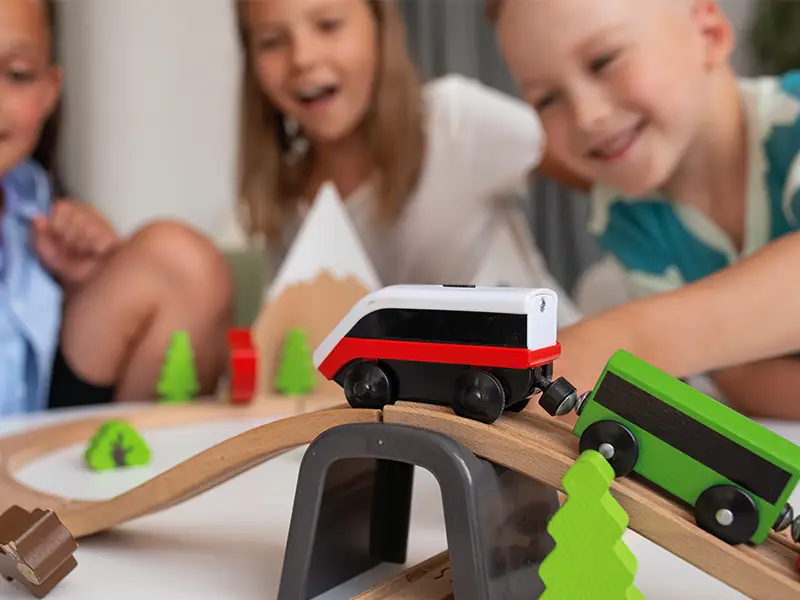
Our Speech-Language Pathologists (SLPs) hold master’s degrees in speech-language pathology. Additionally, our certified SLPs hold the American Speech-Language-Hearing Association’s Certificate of Clinical Competence (CCC), and clinical fellows work under their supervision. Like all therapy at Speech Pathway, speech therapy is client directed and play based, and treatment plans and goals are built around your child’s needs. We offer therapy in individual, small group, and large group settings.
Parent and caregiver involvement is essential to a child’s success, so parents are encouraged to observe and participate in therapy sessions.
How speech therapy can help your child
Our SLPs evaluate and treat:
Articulation and phonological disorders
Trouble saying sounds clearly, or sound patterns that make speech hard to understand.
Expressive and receptive language disorders
Trouble putting words together or understanding what others say.
Speech and language delays in toddlers
Late talkers and children who aren’t combining words yet.
Childhood apraxia of speech
Difficulty planning the movements needed for speech. We have two highly trained apraxia specialists who are listed on the Apraxia Kids National Registry.
Stuttering and fluency disorders
Trouble speaking smoothly, including repeating sounds or words, stretching sounds, or getting stuck on words.
Pragmatic and social communication
Conversation skills, taking turns, and using language with others.
Voice and resonance disorders
Trouble with voice quality, pitch, loudness, or how sound resonates through the nose and mouth.
Feeding and oral motor disorders
Feeding evaluations are led by our SLPs, with input from our OTs on the sensory side of feeding.
Communication support
Related to autism, Down syndrome, cerebral palsy, cleft lip and palate, traumatic brain injury, and other genetic, chromosomal, and neuromuscular conditions.
Augmentative and Alternative Communication (AAC)
Tools and strategies that help children communicate when they have difficulty using spoken words, including gestures, picture boards, or speech-generating devices.
Feeding therapy for ages 0 to 21
Speech Pathway offers feeding therapy for children and young adults from birth to age 21. Our Feeding Team provides feeding and swallowing therapy for children who have difficulty eating or drinking.
Who it can help
Feeding therapy may be a fit if your child:
- Eats a limited number of foods
- Has trouble chewing all of their foods
- Coughs while eating or drinking
Our Feeding Team
Our Feeding Team includes speech-language pathologists and a Registered Behavioral Technician. They use behavioral methods and systematic desensitization methods, including the Sequential Oral Sensory (SOS) Approach to Feeding, a program the team has been trained in.
How to get started
Feeding evaluations are led by our SLPs, with input from our OTs on the sensory side of feeding. Before the evaluation, families complete our intake form on the Get Started page. Questions? Call 405-603-6622.
When should my child see a speech-language pathologist?
Many families chalk up speech problems to not listening or a cute “quirk.” Consider a speech-language evaluation if your child:

- Has trouble imitating sounds made by others
- Makes only a few sounds and is hard to understand
- Is not combining words by 24 months of age
- Stops saying sounds or words they had already mastered, or uses speech and language less than before
- Has difficulty following directions
- Has difficulty communicating basic needs
- Doesn’t engage in conversations with others
- Has changes in communication or thinking skills after an illness, injury, or surgery
This list isn’t complete. If you have any concerns about your child’s speech or language development, we strongly encourage a screening. To see what most children are doing at each age, check ASHA’s Developmental Milestones: Birth to 5 Years or the CDC’s Learn the Signs. Act Early. milestones.
Meet Speech Pathway (0:31)
Why families choose Speech Pathway
We believe in family-centered care, which means we involve the whole family in your child’s treatment plan, from their initial evaluation to the time they graduate. We work with you and your family to achieve their goals.
Speech, OT, and ABA under one roof
Speech therapy, occupational therapy, and ABA therapy all happen at our clinic, so your child’s team can coordinate care and work toward the same goals.
Our clinic is led by Clinical Director Emily Hathaway, M.S., CCC-SLP, who has been practicing speech-language pathology for 16+ years.
Birth to age 21
We serve children and young adults from birth to age 21 at our clinic on the northwest side of Oklahoma City, conveniently located off 122nd and Council.
What a speech-language evaluation looks like
A speech-language evaluation at Speech Pathway has three parts, followed by your child’s treatment plan. A Speech-Language Pathologist leads the evaluation. Speech evaluations take about 1.5 to 2 hours.
Before you begin: A parent or legal guardian must be present during the evaluation.
If you’re using insurance, you’ll need a referral from your child’s primary care doctor. You can sign the medical release on our intake form so we can request it, or ask your doctor’s office to fax it to (405) 722-3244. Self-pay families don’t need a referral.
Case history: complete our intake form
Before the evaluation, you’ll fill out our intake form on the Get Started page. Have photos of the front and back of your insurance cards ready. This lets your child’s SLP review medical history, school, background, and input from teachers and other providers ahead of time. Questions? Call our front desk at 405-603-6622.
Family interview
During your evaluation, you’ll talk with the SLP about your concerns and your goals for your child’s communication.
Standardized and non-standardized measures
Your SLP will determine if a standardized assessment is appropriate for your child, or if they will instead use another form of assessment. These can include parent questionnaires, skilled observation, language samples, checklists, and criterion-based measures. Areas assessed may include understanding and using language, speech sounds and oral-motor skills, social language, voice, fluency, and a hearing screening.
Results and treatment plan
Your child’s SLP will integrate all of the data they collected during the assessment to complete an evaluation report, as well as a treatment plan that is individualized to your child’s specific needs.
Please allow up to 10 business days for the completion of reports.
Insurance, SoonerCare, and self-pay
We accept most major insurance policies. Some are in-network and others are out-of-network. Once you complete our Get Started form, we will contact you about your insurance coverage.
Prior authorization: SoonerCare always requires prior authorization before therapy can begin. Private insurance plans vary. Some require it and some don’t, and more of them are requiring it these days.
Insurance
We are in-network with most plans from Blue Cross/Blue Shield, Tricare, HealthChoice, OSMA, Medicaid/SoonerCare, United Healthcare, Oklahoma Health Network, and WebTPA.
SoonerCare / TEFRA
TEFRA can make SoonerCare benefits available to children with disabilities who wouldn’t otherwise qualify because of family income. Learn about TEFRA
Self-pay
Self-pay is the quickest way to get started. You’ll need to decide before your first appointment whether you will use insurance or pay privately. Self-pay rates for speech evaluations and sessions are listed on our Rates & Payments page.
What families say
★★★★★
“When my child first started going for speech therapy he was unable to verbally express his wants and needs. He’s now receiving both speech and ABA services and his communication skills have improved drastically… If you are second guessing on ABA services or any other services they offer I’m here to tell you just take the leap. You will not regret it.”Alejandra O. · Google review
★★★★★
“I cannot stop recommending them for speech, occupational, or aba services to anyone and everyone who simply mentions needing help.”Kendra C. · Google review
Ready to take the next step?
Whether you’re just starting to explore speech therapy in OKC or you’re ready to schedule an evaluation, we’d love to hear from you.
Location
8007 NW 122nd St.
Oklahoma City, OK 73142
Directions
Hours
Monday – Friday
7:30 a.m. – 7:00 p.m.
By appointment only
Phone
Reviewed by Kylie Hilliard, M.A., CCC-SLP